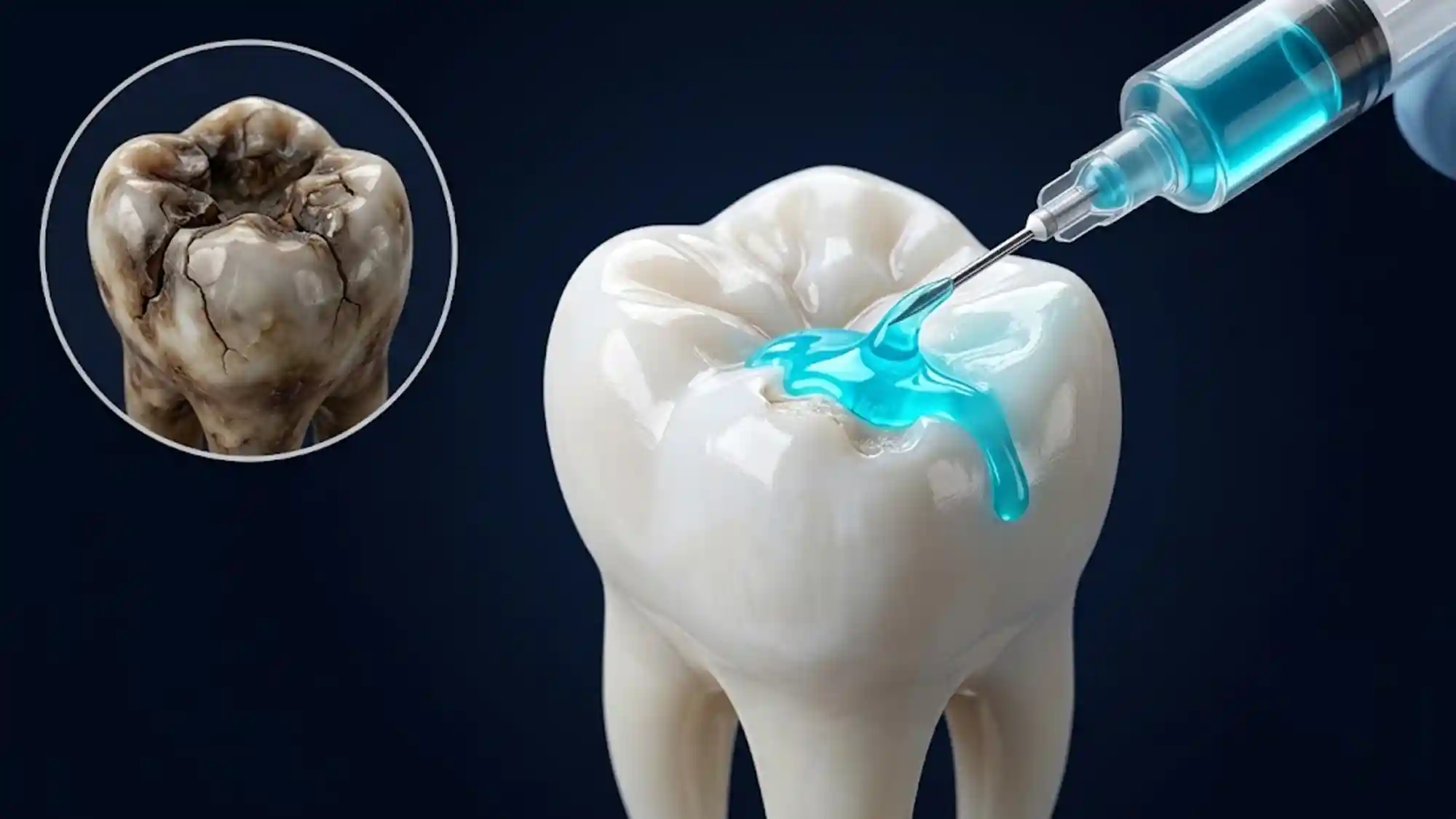
A new protein-based gel developed by scientists at the University of Nottingham could offer a promising way to repair damaged tooth enamel. Unlike ordinary fluoride treatments, the new material is fluoride-free and is designed to help teeth rebuild lost mineral. In simple terms, it works like a tiny repair crew, filling damaged areas and helping the tooth regain its strength. The research was carried out by scientists from the University of Nottingham’s School of Pharmacy and Department of Chemical and Environmental Engineering, together with an international team of researchers. The findings were published in Nature Communications in November.
The gel can be quickly applied to teeth in much the same way dentists apply standard fluoride treatments. But instead of simply protecting the remaining enamel, this protein-based material imitates important features of the natural proteins that guide enamel formation during early life. Once applied, it forms a thin but strong layer that enters small holes and cracks in the tooth. It then acts like a scaffold, drawing calcium and phosphate ions from saliva and guiding them towards damaged areas. In this way, the tooth’s own surroundings become part of the repair process. As the saying goes, “a small stitch in time saves nine”, and repairing early enamel damage could help prevent bigger dental problems later.
This process is known as epitaxial mineralisation, a technical term describing the controlled growth of new mineral on an existing mineral surface. The newly formed material is arranged in an organised way and becomes integrated with the natural tooth tissue. Rather than simply covering the damage like a coat of paint, the gel helps rebuild the architecture of enamel itself. This is important because dental enamel has a highly organised structure that gives it its remarkable hardness and resistance. In this sense, the gel acts like a construction blueprint, helping minerals rebuild the missing structure piece by piece.
The researchers also found that the material could be applied directly to exposed dentine, the layer underneath enamel. When placed on dentine, the gel can encourage the formation of an enamel-like protective layer. This could have several practical benefits, including helping to manage tooth hypersensitivity and improving the surface available for dental restorations. The idea is simple but powerful: instead of only treating the discomfort caused by exposed dentine, scientists are trying to build a new protective barrier over it.

Enamel degradation is one of the major contributors to tooth decay and is linked to dental problems affecting almost half of the world’s population. These conditions can result in infections and tooth loss and may also be associated with diseases such as diabetes and cardiovascular disease. Unlike many tissues in the body, enamel does not naturally regenerate once it is lost. The tooth has, in a way, a one-way door when it comes to enamel. Once that protective layer is seriously damaged, the body cannot simply grow it back. Current approaches, including fluoride varnishes and remineralisation solutions, mainly help reduce further damage or restore minerals to a limited extent rather than fully rebuilding lost enamel.
Dr Abshar Hasan, a Postdoctoral Fellow and the leading author of the study, explained the importance of the approach. “Dental enamel has a unique structure, which gives enamel its remarkable properties that protect our teeth throughout life against physical, chemical, and thermal insults,” he said. “When our material is applied to demineralised or eroded enamel, or exposed dentine, the material promotes the growth of crystals in an integrated and organised manner, recovering the architecture of our natural healthy enamel.”
The researchers also tested how well the regenerated tissue could withstand conditions similar to everyday life. These tests included tooth brushing, chewing and exposure to acidic foods. The regenerated enamel showed mechanical behaviour similar to healthy enamel under these simulated conditions. In other words, the new material was not merely putting on a temporary show. It was being tested against the daily wear and tear that teeth face. From morning coffee to evening meals, teeth constantly enter a battlefield of pressure, friction and acids.
Professor Alvaro Mata, Chair in Biomedical Engineering and Biomaterials, who led the study, said the technology was developed with both clinicians and patients in mind. “We are very excited because the technology has been designed with the clinician and patient in mind,” he said. “It is safe, can be easily and rapidly applied, and it is scalable.”
The material is also versatile, which could allow it to be developed into different products for people of different ages who experience enamel loss or exposed dentine. Its potential applications could range from helping protect weakened enamel to supporting treatments for sensitivity and dental restoration. This flexibility gives the technology a wider playing field, rather than limiting it to a single dental problem.
The researchers have already begun efforts to move the technology towards practical applications through their start-up company, Mintech-Bio. The team hopes to have a first product available next year. If further development and testing are successful, this innovation could provide dentists with a new tool for repairing damaged tooth surfaces. The old idea of “prevention is better than cure” may soon gain a new scientific meaning, with prevention and repair working hand in hand.
At the heart of the research is a fascinating biological idea: nature already knows how to build enamel, and scientists are learning how to copy its instructions. The gel does not simply act as a bandage for a damaged tooth. Instead, it provides the conditions and structure needed for minerals from saliva to rebuild the surface. It is a case of science taking a page from nature’s own handbook.
For patients, the future possibility is especially interesting. A dental treatment that can be applied quickly, strengthen damaged enamel and create an enamel-like layer over exposed dentine could change how some forms of tooth damage are managed. The technology is still moving towards clinical use, so more research and testing will be needed before it becomes a routine treatment. But the message from the laboratory is clear: when enamel loses its strength, scientists may finally be finding a way to give teeth a second chance.
| Source: New gel restores dental enamel and could revolutionise tooth repair. Br Dent J 239, 816–817 (2025). https://doi.org/10.1038/s41415-025-9482-9 |