Long before humans walked across England, the land was home to strange and terrifying creatures. One of them was Praearcturus gigas Woodward, a large arthropod whose exact identity has puzzled scientists for more than a century. Fossils of this creature come from the fluvial St Maughans Formation of the Lower Devonian, specifically the Lochkovian, within the Old Red Sandstone of England and Wales. In simple words, this was a very early chapter in Earth’s history, when the world looked almost like an alien landscape. The ancient environment was a stage, and giant arthropods were among its most remarkable actors.
Praearcturus gigas was originally described as an isopod in the nineteenth century. Later, scientists compared it with several different groups of arthropods before it was re-described as a gigantic scorpion in the 1980s. That interpretation, however, was later challenged, creating a scientific mystery around the fossil. Its identity became something of an evolutionary puzzle, with each new study adding another piece to the picture. As the old saying goes, “truth will out”, and modern technology has now helped scientists take another careful look at this ancient animal.
Recently, Howard, Garwood, Edgecombe and Legg carried out a modern revision of the material. Using camera lucida drawings, light photography and tomographic data, they re-described the type material and assigned several other specimens from the same formation to this taxon. These methods allowed the researchers to examine details that earlier studies could not clearly resolve. It is a bit like turning up the brightness on a very old photograph, suddenly, structures that were once difficult to see become much easier to understand.
The researchers identify Brontoscorpio anglicus Kjellesvig-Waering and Bennettarthra annwnensis Fayers et al. as junior synonyms of P. gigas. In scientific terms, this means that these names are now considered to refer to the same taxon rather than separate animals. What once looked like several different pieces of the ancient puzzle may actually belong to one remarkable creature. The fossil record, in this sense, has been quietly rewriting its own story.

Several features supporting a scorpion affinity are present in P. gigas. These include large pedipalps with a fixed and movable finger, a stridulatory surface on one of the coxae, and an elongate subtriangular sternum morphology. These features are also shared with the unambiguous Silurian scorpion Eramoscorpius brucensis Waddington et al., which lived during the Wenlock in Canada. Such anatomical similarities provide important clues about where P. gigas belongs on the evolutionary tree.
The pedipalps are especially interesting because they resemble the grasping structures seen in scorpions. In a simple analogy, they can be thought of as ancient pincers, built for gripping rather than merely decoration. These structures, together with other anatomical characters, strengthen the case that P. gigas was indeed related to scorpions. The fossil may be silent, but its anatomy speaks volumes.
Yet P. gigas was not simply an ordinary scorpion made larger. Uniquely among scorpions, it has lateral epimera on the mesosomal tergites. These unusual structures make the animal particularly interesting because they are not commonly seen in other scorpions. Evolution sometimes writes its own rulebook, and P. gigas appears to have carried a few unusual pages of its own.
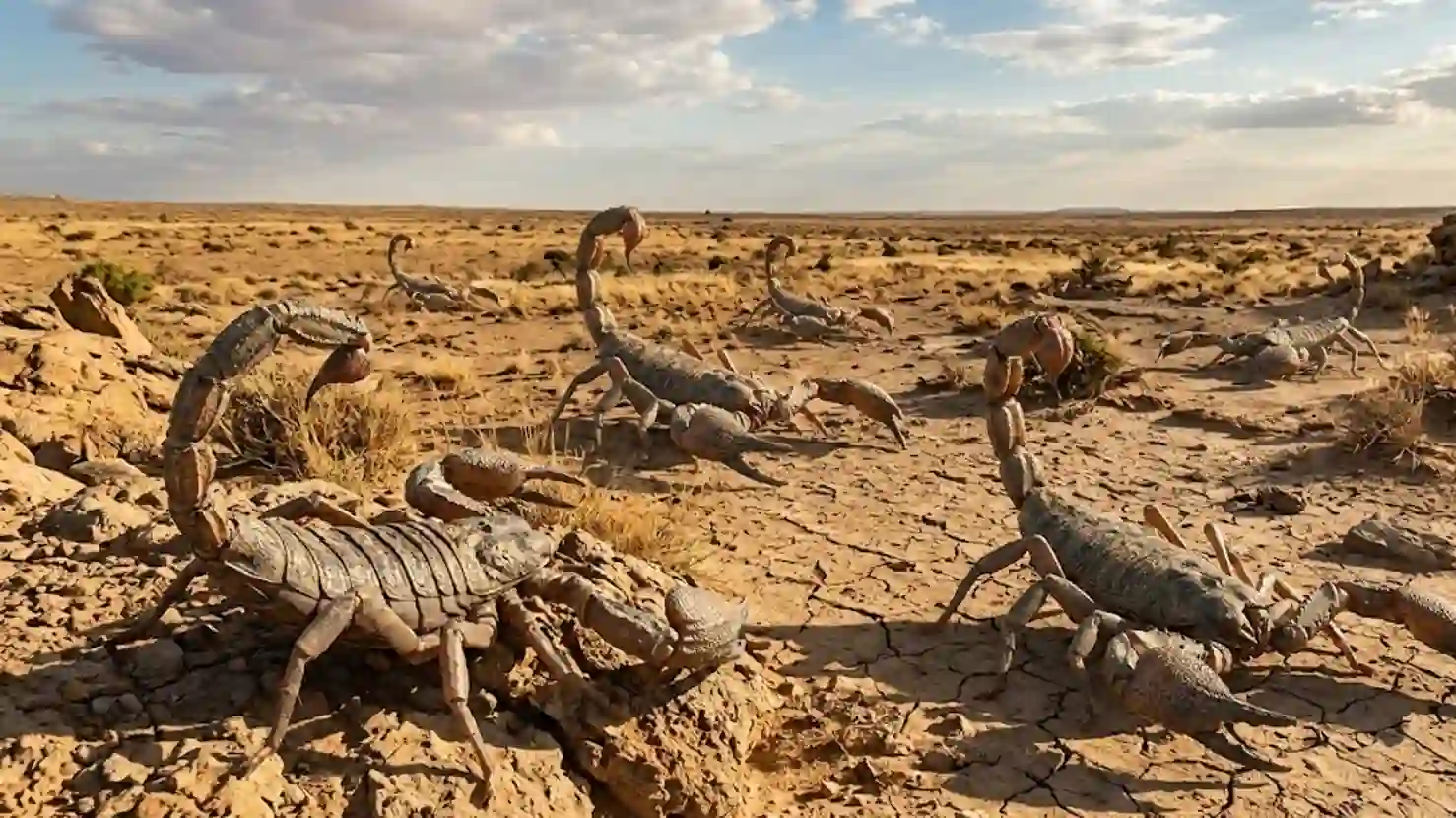
The environment in which these fossils were preserved adds another twist to the story. The fossils were found in a fluvial environment, meaning they were associated with ancient river systems. Because of this setting, the researchers suggest that P. gigas may have been aquatic or amphibious. Rather than being confined to dry land, this giant arthropod may have moved through or around ancient waterways. In that sense, it may have been less like a modern desert scorpion and more like a creature with one foot on land and another in the water.
This possibility makes the animal even more fascinating. An amphibious or aquatic scorpion would have occupied a very different ecological niche from most scorpions known today. The ancient rivers may have provided both shelter and hunting opportunities, turning the water’s edge into a prehistoric hunting ground. Nature, as always, seems to have had more tricks up its sleeve than we might expect.
The researchers also review the evidence for scorpion gigantism and discuss the evolutionary context of a large arachnid predator in the Early Devonian. Gigantism among ancient arthropods has long attracted scientific attention because body size can influence how an animal moves, hunts and interacts with its environment. A very large predator would have occupied an important position in its ecosystem, potentially acting like a prehistoric heavyweight in the food web.
The phrase “the bigger, the better” does not always hold true in evolution, but large body size can offer advantages in certain environments. At the same time, becoming larger also brings challenges, including the need for more energy and suitable environmental conditions. P. gigas therefore provides an important opportunity to study not only how scorpions evolved, but also why some ancient arthropods reached remarkable sizes.
The revision of Praearcturus gigas gives scientists a clearer picture of this unusual Early Devonian animal. What was once described as an isopod, later considered a gigantic scorpion, and then questioned again, has now received a detailed modern assessment. The story is a reminder that science is not carved in stone. It changes when better evidence arrives.
For modern readers, the discovery offers a glimpse into an England that would have been almost unrecognisable. There were no cities, roads or humans, but ancient rivers and ecosystems supported remarkable arthropods. P. gigas may have been one of the largest predators in its environment, turning the ancient landscape into a world where a scorpion could become a true giant.
The study therefore does more than settle a long-running debate about the identity of a fossil. It opens a window into the evolutionary history of scorpions and the unusual ecosystems of the Early Devonian. This ancient giant reminds us that Earth’s past was full of surprises, and sometimes, the most frightening creatures are hiding quietly inside rocks.
| Source: Howard, R.J., Garwood, R.J., Edgecombe, G.D. and Legg, D.A., 2026. A revision of Praearcturus gigas: a giant scorpion from the Lower Devonian (Lochkovian) of Britain. Palaeontology, 69(3), p.e70064. |